OpenAPI-driven · terminal-first · agent-ready
>_ lazyapi
Explore, test and automate any API straight from its OpenAPI spec. A terminal UI for humans, a CLI for CI, an MCP server for agents.
No collections to keep in sync: every response is checked against the spec, and your tests are JavaScript files committed next to it.
{
  "id": 1,
  "name": "Ana",
  "email": "ana@example.com"
}One spec, three interfaces
The OpenAPI document is the single source of truth. There are no collections to export, no environments to rebuild: point LazyAPI at your spec and every operation is ready to explore, send and test.
Browse operations grouped by tag, edit params, auth, headers and body, send with alt+enter and read the response with highlighting, jq filters, cookies, timing and checks.
$ lazyapi api.ymlRun every operation with its checks and tests, in parallel, with retries. Reports as pretty text, JSON, JUnit or TAP, and the same exit codes everywhere.
$ lazyapi run api.yml --output junitAn MCP server confined to a root directory: agents list and describe operations, send requests, write tests and flows, and run them, with readable failures.
$ lazyapi mcp --root .See it in action
Operations grouped by tag. s sends the selected one and the response shows up right there.
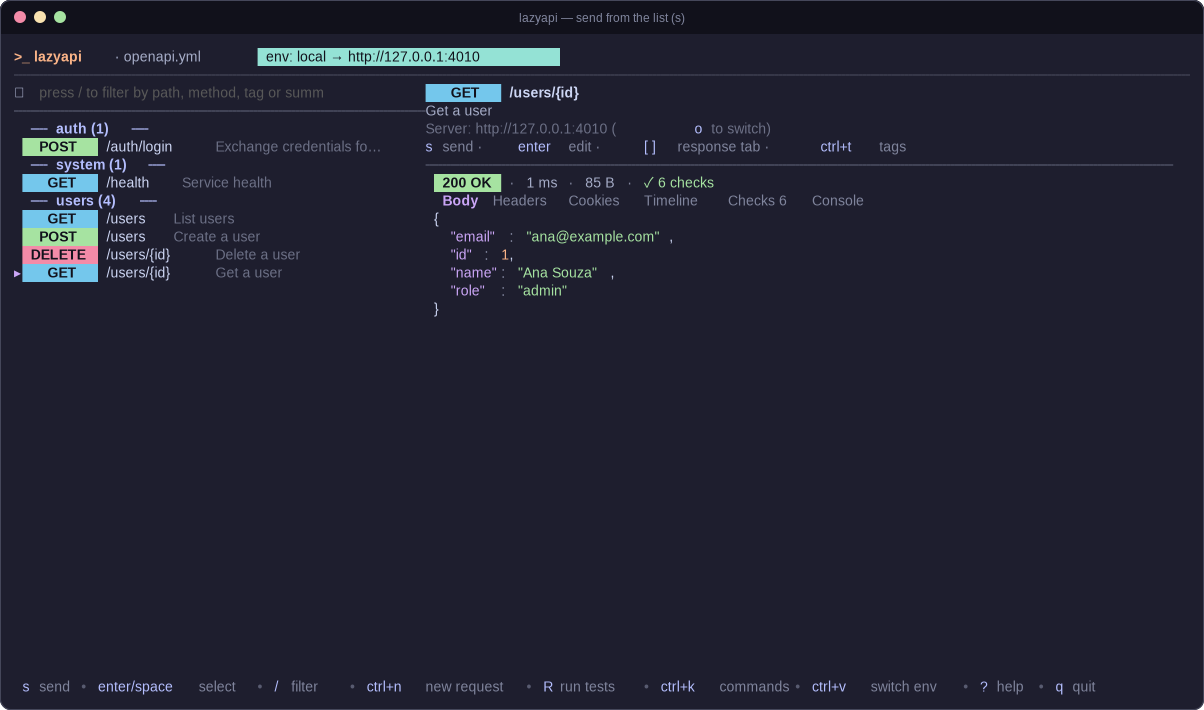
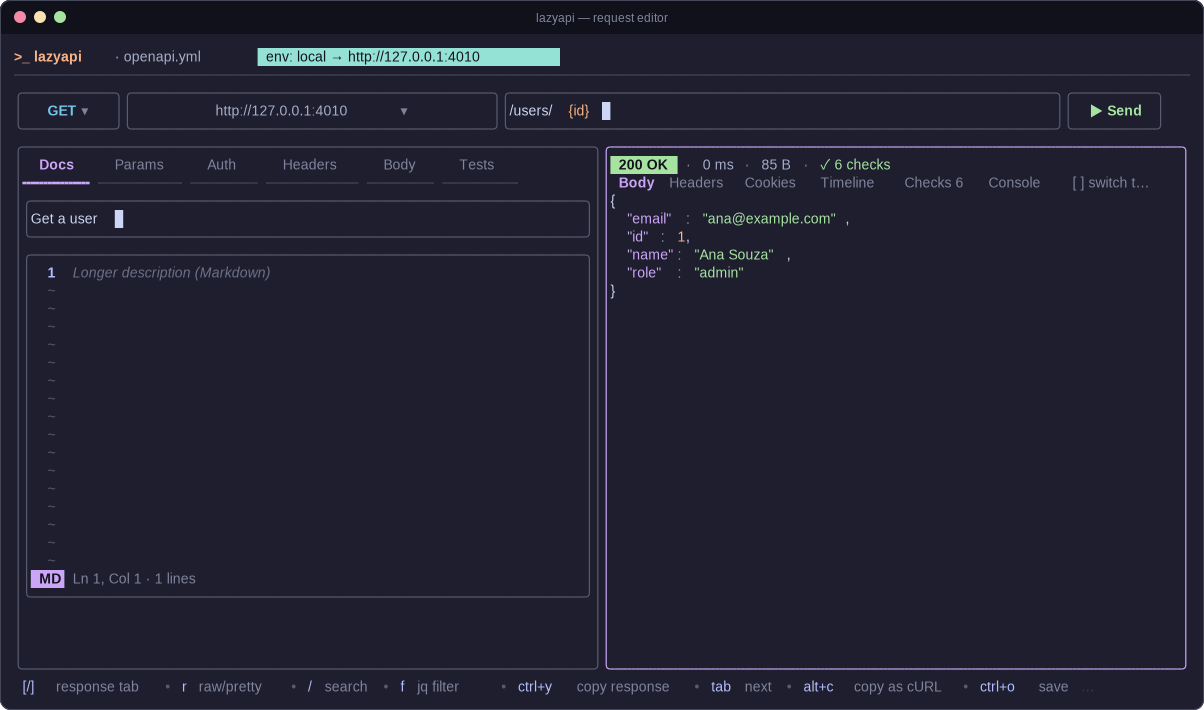
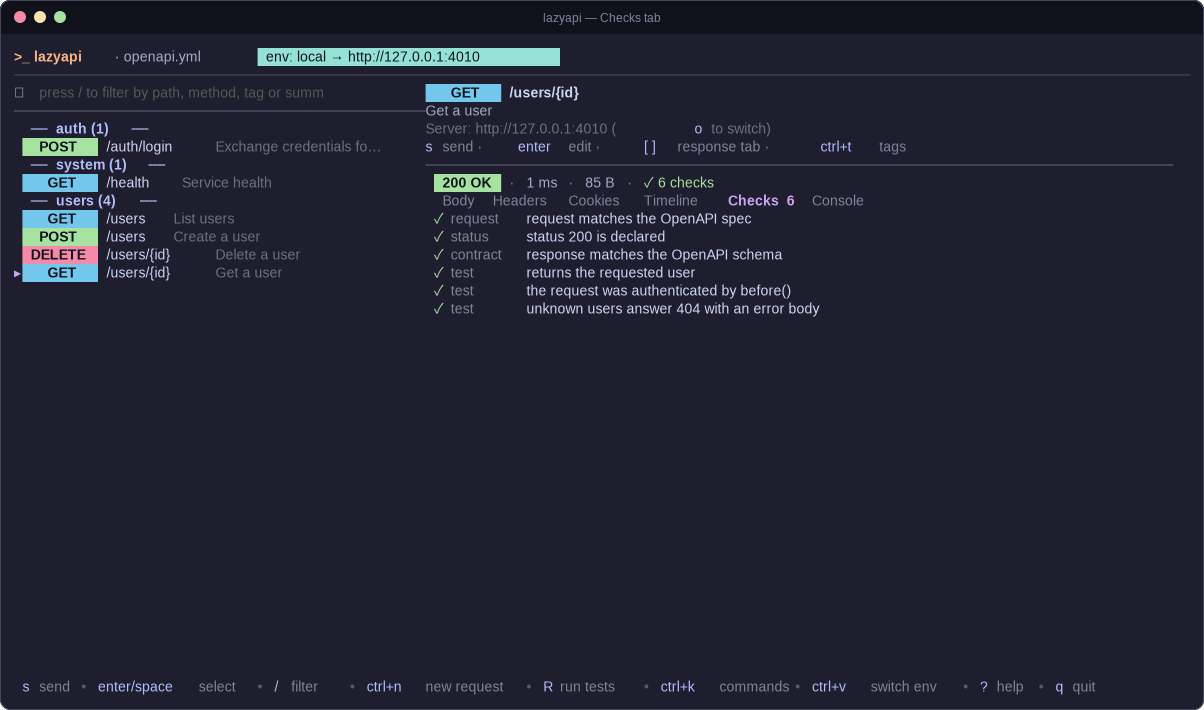
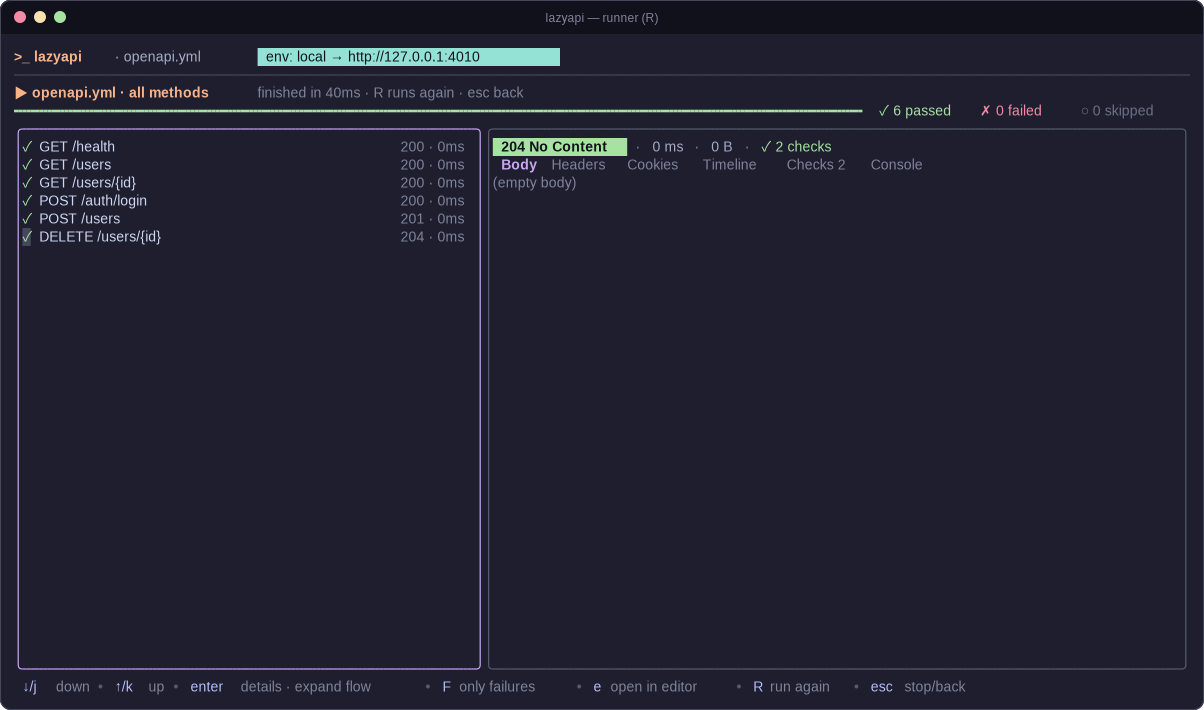
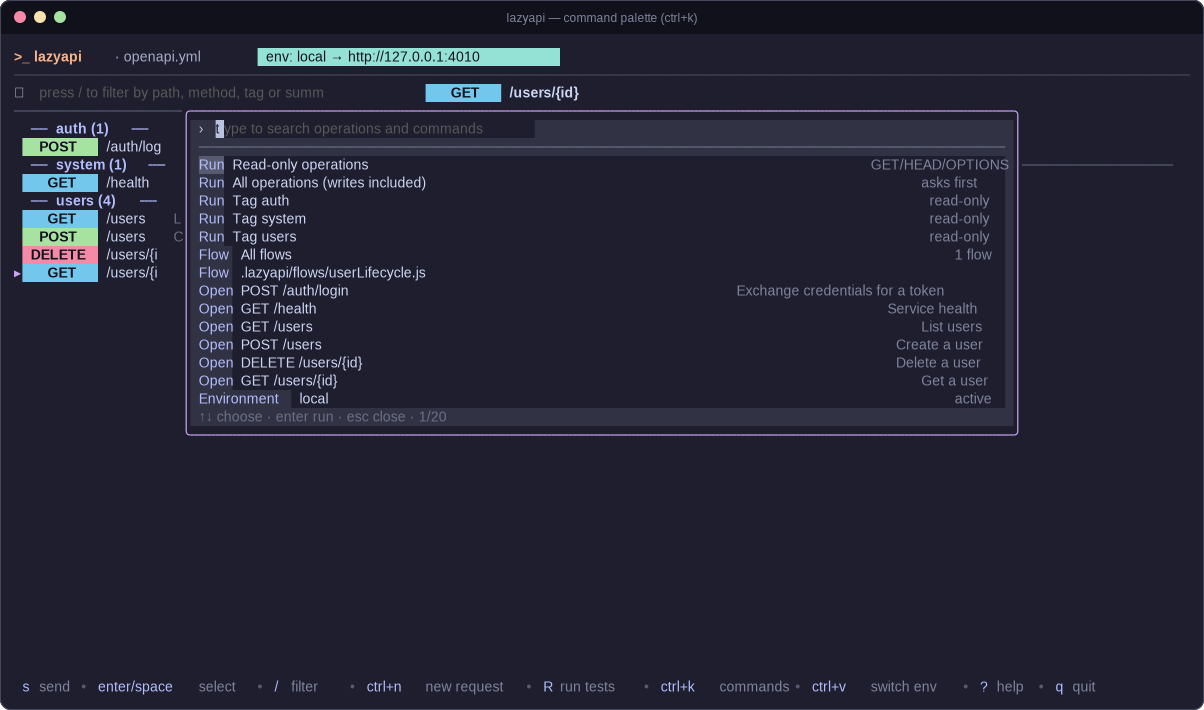
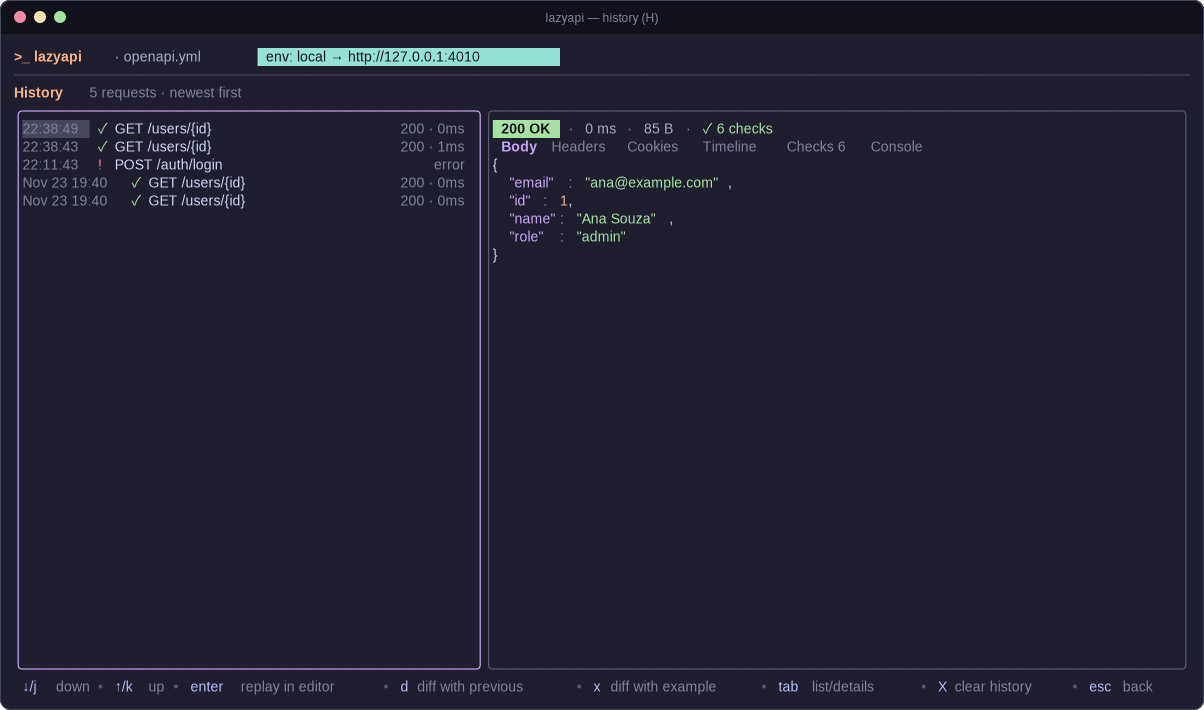
real captures of lazyapi examples/openapi.yml · ← → or [ ] to switch
Every response is checked
Each exchange — from the TUI, the CLI, a flow or an agent — goes through the same checks. --no-contract turns off request and contract for deliberately invalid calls.
Two minutes, no server needed
git clone https://github.com/githiago-f/lazyapi.git && cd lazyapi
go build -o lazyapi ./cmd/lazyapi

./lazyapi mock examples/openapi.yml &          # fake API from the spec's examples
./lazyapi run examples/openapi.yml --methods all --flowsPassed GET /users/{id} — 200 OK (1ms)
[PASS] request: request matches the OpenAPI spec
[PASS] status: status 200 is declared
[PASS] contract: response matches the OpenAPI schema
[PASS] returns the requested user
========================================
Operations: 7 passed, 0 failed, 0 errors, 0 skipped (20ms)
Checks: 40 passed, 0 failedThen open the TUI on the same spec: ./lazyapi examples/openapi.yml. More in Getting Started.
Tests are JavaScript next to your spec
import { z } from "https://esm.sh/zod@3.23.8"   // URL imports, pinned in .lazyapi/lazyapi.lock
import { login, bearer } from "./helpers.js"    // relative imports

test("returns the user", () => {
  expect(response).toHaveStatus(200)
  expect(response.json()).toHaveProperty("email")
})

test("chained call with a token", () => {
  const me = lazyapi.send("getUser", { params: { id: "1" }, headers: bearer(login()) })
  expect(me).toMatchSchema()
})paths:
/users/{id}:
get:
operationId: getUser
x-lazyapi-tests: .lazyapi/tests/getUser.jsconst created = lazyapi.send("createUser", { body: { name: "Ana", email: "ana@example.com" } })
test("created", () => expect(created).toHaveStatus(201))
const removed = lazyapi.send("deleteUser", { params: { id: String(created.json().id) } })
test("deleted", () => expect(removed).toHaveStatus(204))Scripts run in a sandbox with request, response, env, vars, lazyapi.send, faker, test, expect and console. See Test Scripts.
Git-native
Everything lives in .lazyapi/ next to the spec and is versioned with it. Secrets and local state stay out of git.
api/
  openapi.yml
  .lazyapi/
    config.yml          named environments: server, vars, HTTP options, credentials
    envs/staging.env    variables            (committed)
    secrets/staging.env tokens, passwords    (git-ignored, mode 600)
    tests/  flows/  data/
    lazyapi.lock        pinned URL imports
    .local/             drafts and history   (git-ignored)
Read Environments & Auth for the details.
Exit codes
| Code | Meaning |
|---|---|
0 | everything passed |
1 | a check failed |
2 | usage error |
3 | something could not run (spec, network, config) |